

INDEX
Why do dogs need bodywork or chiropractic treatment?
“The reason why the Dog Bodywork Institute provides chiropractic care for dogs is because it helps them walk more comfortably.
In our canine bodywork sessions, we sometimes meet dogs whose posture changes dramatically—making it much easier for them to walk.
The dog you see in the video is 17 years old. She had a hunched back, short steps, and would often trip and fall. I had the opportunity to work with her for about six months.
After she passed, her owner said, ‘She was lucky to be able to walk right up to the end. That made her happy.’
“It’s sad, but no matter how much love and care we give them, parting with our beloved dogs is something we all must face one day.
When that moment eventually arrives, the longer our dogs live, the fewer choices remain for what we can still do for them.
If a dog can still walk today, there’s a good chance they’ll still be with us tomorrow, and the day after that.
Even if their eyesight fades, their hearing weakens, and their body grows thin and frail — if they still have the will to walk, then there is still something we can do for them.
Since a dog’s time moves faster than ours, the Dog Bodywork Institute encourages owners to take part in caring for their dogs at home, to help them stay mobile and walk with ease.
If you know where to touch and how to care — based on anatomical knowledge — then it’s something anyone can do.
So that our dogs can stand and walk on their own, and live comfortably until their very last moments.
“I truly hope that every dog owner can come to know and use this technique.
What exactly is done in dog bodywork therapy?
It’s simply about using your hands to gently relax the muscles. Nothing more.
Around 2013, when I started massaging dogs, most people didn’t take me seriously. When I said I was turning it into a profession, they thought I was kidding and laughed it off. That’s exactly why people believed massaging dogs could never be a real profession. That’s exactly why people believed massaging dogs could never be a real profession.
The reason the Dog Bodywork Institute places such a strong emphasis on understanding canine anatomy and applying that knowledge in hands-on care comes down to one simple truth: dogs can’t speak.
The dog in this video continued to walk for another three years, until she peacefully passed away at the age of 15.
When people see videos like this, they often say it looks like magic. But I’m not a magician. Because it’s not magic, there’s a clear explanation for this change — it comes down to muscle stiffness and tension.
And the best part is, muscle tension can be relieved by the owners themselves.
What can it do for dogs?
When you loosen and relax a dog’s muscles, it becomes easier for them to walk.
Why does it become easier for dogs to walk? There are three main reasons:
〇Improved posture
〇Increased stride length
〇Improved muscle performance and easier activation
“Let me show you a real-lif e case.
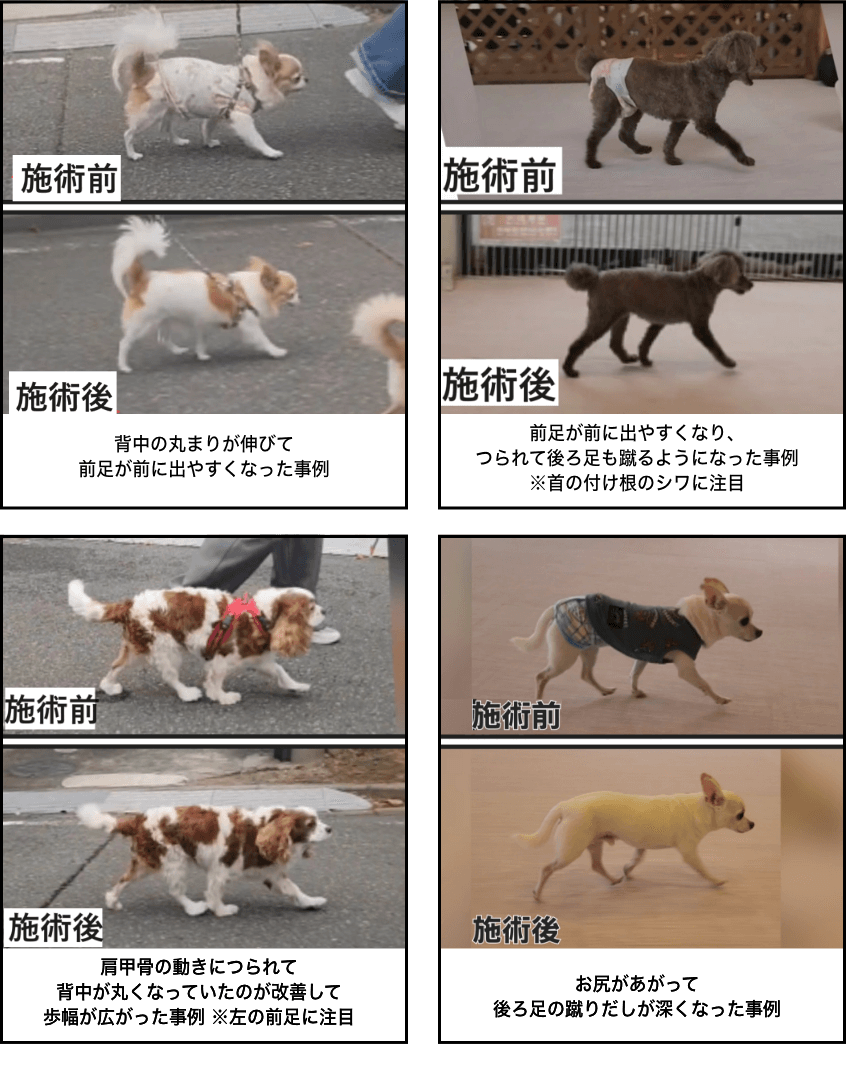
The changes in posture and walking didn’t happen because we told the dog to ‘stand up straight’ or ‘take bigger steps.’ Dogs don’t follow verbal instructions like that.” It’s only natural — dogs don’t understand human language, and if they could correct their posture just by being told, they wouldn’t have poor posture to begin with. The changes in posture and movement were made by the dog itself.
Why did the change happen? The reason is simple — because deep down, the dog wanted to stand and walk like that.
They wanted to stand the way they always had, and to walk with a full stride — but their muscles had become stiff, and even though they wanted to move their front legs forward, they couldn’t. There comes a time when they want to straighten their back but can’t, when they try to lift their hips but just aren’t able to.
This tends to happen to most dogs around the age of 12.
It’s easy to imagine the difference in muscle mass in the limbs by the time a dog reaches 15 — between one who received care at age 12 to maintain a wide stride, and one whose muscle stiffness was left untreated, forcing them to walk with shortened strides.
That’s why I hope you’ll start caring for them now — while they can still walk.
Why does a dog’s posture become misaligned?
For both dogs and humans, postural changes and difficulty walking are inevitable with age — and of course, muscle loss affects everyone equally. But there’s one important truth I really want you to know. And that is — muscle loss doesn’t happen all of a sudden.
Postural decline and reduced stride length also begin gradually and progress little by little over time. “And dogs are very good at compensating for these changes — which is why their owners often don’t notice. I truly hope you’ll begin care before walking becomes difficult — before their posture deteriorates beyond recovery.
Because every dog who lives a long life will inevitably experience muscle stiffness.
Dogs have a posture that places much more strain on their muscles just by standing compared to humans.
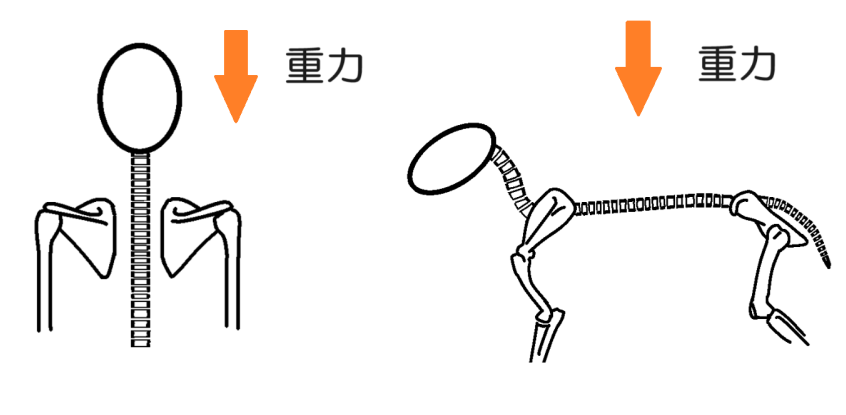
The human spine is stacked vertically, like building blocks. To maintain an upright posture, all we humans need to do is keep our balance so that this vertical spine structure doesn’t topple over. In contrast, a dog’s spine runs horizontally and is supported by muscles — much like a suspension bridge. “On top of that, their knees and elbows are always slightly bent — it’s like they’re constantly sitting in an invisible chair.
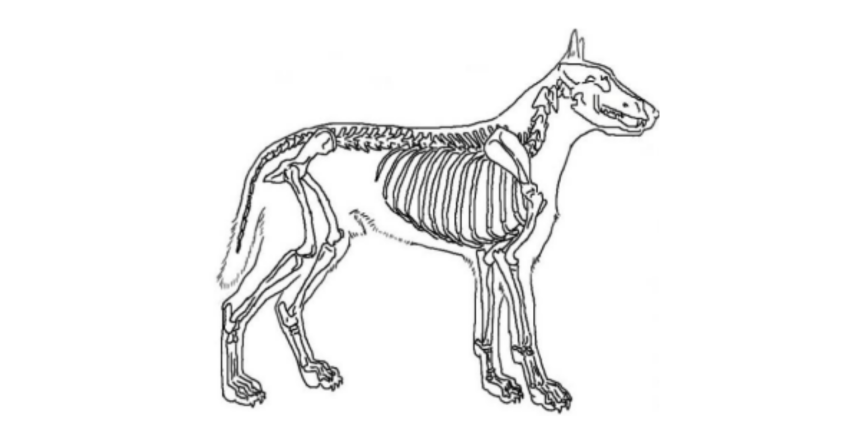
Just maintaining this posture alone is enough to cause muscle tension. And there’s one more unavoidable reason why dogs tend to develop stiffness — it’s because a dog’s direction of movement is always forward.
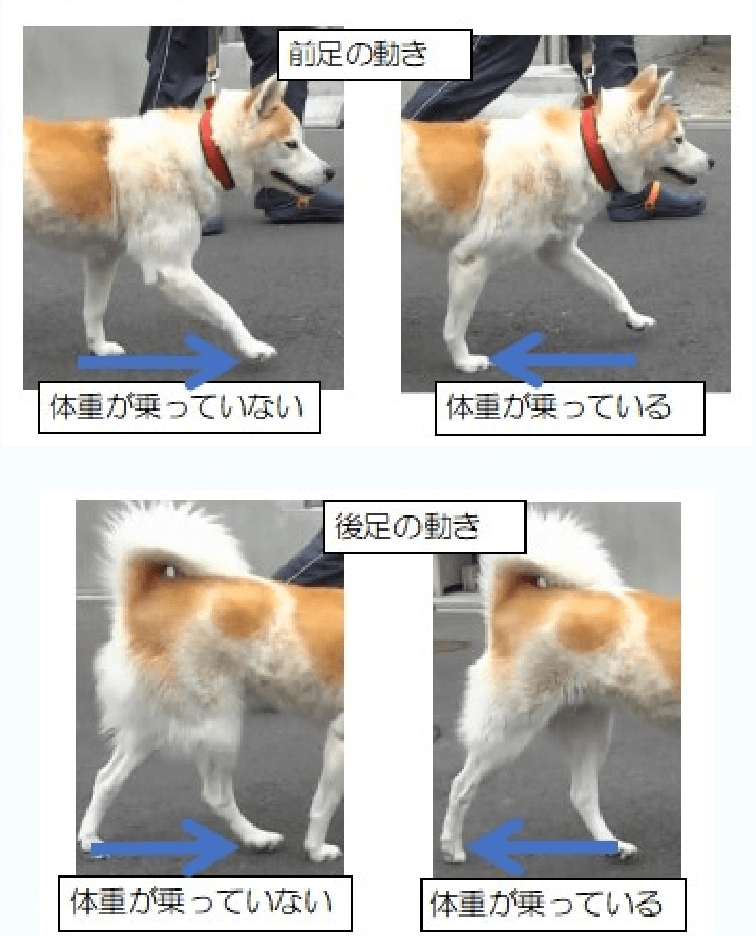
Dogs only walk forward. That’s why the muscles responsible for pushing the legs from front to back — in both the front and hind legs — tend to be overworked. Around the age of 10, the muscles involved in this movement often become stiff and less flexible, which leads to a reduced stride length.
If they continue walking with a restricted stride, muscle loss will gradually accelerate. Some dogs may compensate for a limited stride by twisting or rounding their torso, and over time, this can lead to postural imbalances.
A case where tension in the hamstrings had pulled down the ischium, causing a rounded lower back — and was improved through care.
A case where limited hip mobility led to compensatory swaying of the hips during walking — and was improved through care.
Why does just massaging have an effect?
Why is it that we can confidently say, ‘Even care provided by the owner — someone without professional training — can be effective’? And why does it actually work? It’s because this approach is incredibly simple — by gently touching the muscles, the owner helps the dog become aware of areas where they’re unconsciously tensing up, and allows them to release that tension.
As mentioned earlier, a dog’s posture resembles a suspension bridge supported by the spine, while all four limbs are constantly in a position similar to a wall sit. Whether a dog is highly active or not, by the time they’ve lived for 10 years, they inevitably start to tense up — even while lying down — as if trying to maintain the same posture as when standing. We refer to the state where tension causes joint mobility to become restricted as ‘muscle stiffness’. This ‘muscle stiffness’ is simply a result of the dog unconsciously holding tension without realizing it. By gently touching these areas and helping the dog become aware of them, the dog can then relax naturally.
Muscles that are tense and stiff lose their flexibility, which reduces their performance and makes them harder to use. Perhaps instinctively, dogs seem to know — simply touching their muscle stiffness helps them stop holding tension.
Then, the dog becomes aware that the muscle stiffness is gone and naturally adjusts their posture and gait.
A case of a dog struggling to move its front legs forward, walking while shaking its head.
A case of a dog leaning forward and unable to properly push off with its hind legs.
Don’t ignore the knots – here’s why
Muscle care for every dog as they enter their senior years.
This is the heartfelt wish of the Dog Bodywork Institute. Because care provided by owners is truly effective, we feel even more strongly about this hope.
The reason you should relieve muscle stiffness is simple: it helps maintain ease of walking.
A case where scapular misalignment caused the forelimbs to lose stability and splay outward — which was successfully corrected.
This dog was diagnosed with a dislocated shoulder joint. This dog, who was unable to stand despite wanting to, was able to stand and walk again. She was 18 years old at the time. Since they lived far away, I couldn’t visit often, but thanks to the owner’s devoted care, the dog was able to walk until the very end.
A dislocated shoulder joint cannot be healed through chiropractic care.
Because dogs don’t have a collarbone, all the weight on their front legs is supported by the muscles connecting the shoulder blades to the torso. Naturally, as they become seniors, these muscles lose flexibility and it becomes difficult for them to provide proper support. The before-and-after changes shown in the video are thanks to the improved performance of the muscles supporting the forelimbs, allowing the dog to better support its front legs.
This dog was barely able to walk due to neurogenic muscle contracture. Of course, chiropractic care cannot resolve neurological issues. However, it can reset the muscle habits that have developed as a result.
Do senior dogs have to lose muscle?
Massaging muscles doesn’t automatically build muscle. Unfortunately, chiropractic treatment cannot restore muscle strength lost due to aging. However, if a dog finds it easier to walk, they will naturally start moving more — which can help slow down muscle loss.
Even as they become seniors and then super seniors, dogs still want to walk on their own. That’s why, when muscle stiffness is relieved, dogs are able to stand and walk again.
Having met many dogs like these, I want to say this loudly and clearly. Provide muscle care for your dog when they become a senior.
If you recognize the importance of this and think, ‘I want to help my own dog too,’ please make use of the information on our website.
We have received understanding and support from veterinarians that this technique is based on functional anatomy and is not unscientific.